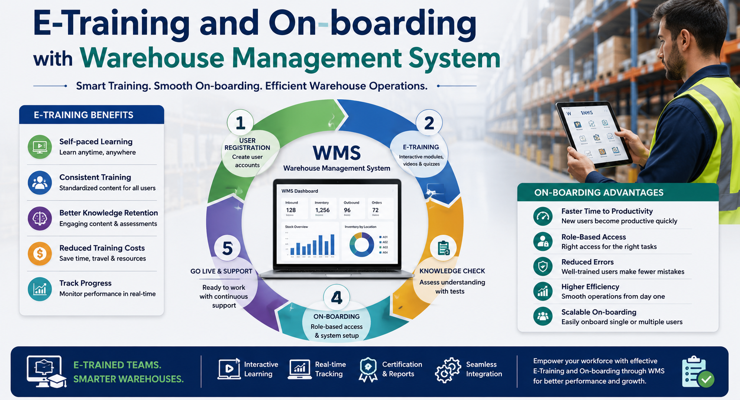
The world today is presenting highly digital warehouses; where efficiency, accuracy, and speed are the key determinants of successful operation. Due to the modernization of the logistics technologies used by organizations, the process of training the employees and their onboarding should also change. The use of Warehouse Management System allows companies to establish well-organized online training programs that enhance productivity and minimise the work of the workforce and decrease the number of operational mistakes.
Training methods are usually manual in nature where inexperienced workers learn by watching the senior workers or trial and error. On the contrary, workflows and task instructions through automated and guided procedures and performance monitoring are offered by means of digital onboarding via the warehouse systems. Firms that use erp software in oman solutions are adopting more and more of the warehouse systems in an effort to establish holistic operational environments.
This change assists organizations to develop competent warehouse teams that can support the current supply chain requirements.
WFMC Structured Workforce Training Warehouse Management System.
Contemporary Warehouse Management System is crucial in scheduling of employee training and day to day operational orientation.
Digital training characteristics will normally consist of:
- Instruction of tasks step-by-step.
- Role-based system access
- Automated work flow alerts.
- Performance feedback in real-time.
- Interactive dashboards
These characteristics enable new hires to learn about the warehouse operations within the shortest time possible, including picking, packing, and inventory flow. Integration with erp system oman platforms, training data of the erp systems is in agreement with the overall operational performance indicators.
Formal system-based training will decrease the reliance on manual training and speed up the process of employee preparation.
Warehouse Management System and Operational Consistency.
Those organizations that use advanced Warehouse Management Systems enjoy standardized workflows that make the onboarding process simplified.
Key advantages include:
- There is consistency in performing tasks in each shift.
- Reduced operational errors
- Better response to emerging technologies.
- Enhanced conformity to the processes.
Any company dealing with a reputable erp software firm or erp firm would be able to connect the warehouse systems to enterprise platforms in order to have uniform operational control.
Digital onboarding can also be done in standardized forms to facilitate scalability of workforce during peak times.
Guided Onboarding Warehouse Management Software.
Modern Warehouse Management Software allows guided onboarding programs that ensure that employees learn by following tasks dictated by the system.
These programs may include:
- Digital learning modules
- Task simulations
- Skills automated tests.
- Workflow training alerts
In lieu of using printed manuals or verbal instructions, employees communicate with the warehouse systems. This practical method enhances good retention and lowers the onboarding process.
Companies that operate on ERP Software ecosystems in most cases combine warehouse onboarding information with HR and performance management systems.
Oman Local Workforce Development Warehouse Management System.
Implementing warehouse management system oman solutions helps in work force development programs in line with the regional logistics development.
Organizations can:
- Educate employees at local level regarding workflow in the warehouse.
- Make sure that the standards of operation are observed.
- Observes productivity standards.
- Enhance warehouse safety consciousness.
Digital onboarding is also beneficial to work around language and communication barriers since it offers visual guidance and prompts in the system.
This strategy promotes the efficiency of the workforce and contributes to the sustainability of the operations in the long term.
Waste Management Systems in Oman Performance Monitoring.
The introduction of WMS in Oman solutions can allow the businesses to track the training process of employees and their performance.
Some of the performance tracking capabilities are:
- Time of task completion analysis.
- Error rate monitoring
- Productivity dashboards
- Report on training completion.
Managers are able to know the areas of skill deficiencies and offer specific coaching to enhance performance of the workforce. It is improved further by integration with Inventory Management Software which provides visibility of the operational processes by connecting the employee activities and inventory results.
This is a data-based strategy that can guarantee continuous improvement of the workforce.
Cloud WMS of Flexible Trainings.
Cloud-Based WMS enables organizations to implement training programs in the different warehouse locations.
Cloud deployment has the following benefits:
- Training modules can be accessed remotely.
- Included in performance data are centralized performance data.
- Easy system updates
- Expandability of operations.
Cloud platforms make me have similar onboarding experiences irrespective of the size or the location of the warehouse. The employees are able to learn processes quicker and the managers have centralized control.
This is very useful in the logistics companies that are growing at a very high pace.
Digital Warehouse Training Impact on Business.
Warehouse systems offer digital training that provides quantifiable operational advantages like:
- Reduced onboarding costs
- Increased rate of employee productivity.
- Increased inventory accuracy.
- Improved working processes.
- Increased adherence to safety measures.
When combined with ERP systems, warehouse training systems help businesses build a single digital ecosystem that reinforces the supply chain performance.
This is a long-term competitiveness strategy in the logistics industry.