Skip to main content
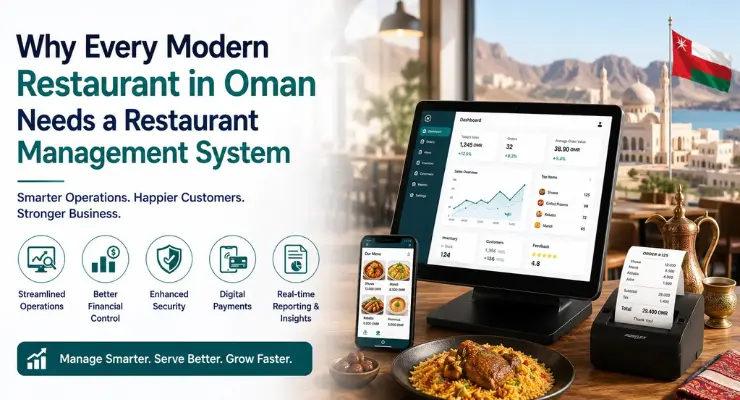
The reasons why every single restaurant in Oman should have a Restaurant Management System:
The past few years have seen the development of the restaurant industry in Oman. The customers have come to demand quick services, correct orders, online payment opportunities, and hassle-free eating. Meanwhile, restaurant owners are struggling with growing issues connected with inventory management, staffing, cost of food, and customer satisfaction.
Modern restaurants require more than conventional ways of management in order to be competitive. They need intelligent technology solutions that will be able to automate the operations and give them real-time view of all facets of the business. In this regard, a restaurant management system is needed.
Hotels and restaurants in Oman, starting with small cafes, fast-food companies, leading up to fine-dining restaurants and restaurant chains, are implementing restaurant management software as a way to enhance efficiency, maximize profitability, and triumph customer experiences.
What the Restaurant Management System?
A restaurant management system refers to a combination of software that is used to run the daily operations of a restaurant through a central system. It integrates several features including processing of orders, billing, control of inventory, employee management, customer relationship management and reporting.
Restaurant owners no longer need to deal with different and disjointed tools and manual processes that are not in sync with each other, but rather run their whole business via one system.
The modern restaurant management solutions also are linked with the ERP Software, which allow the business to simplify its accounting, procurement, payroll and financial reporting among the various locations.
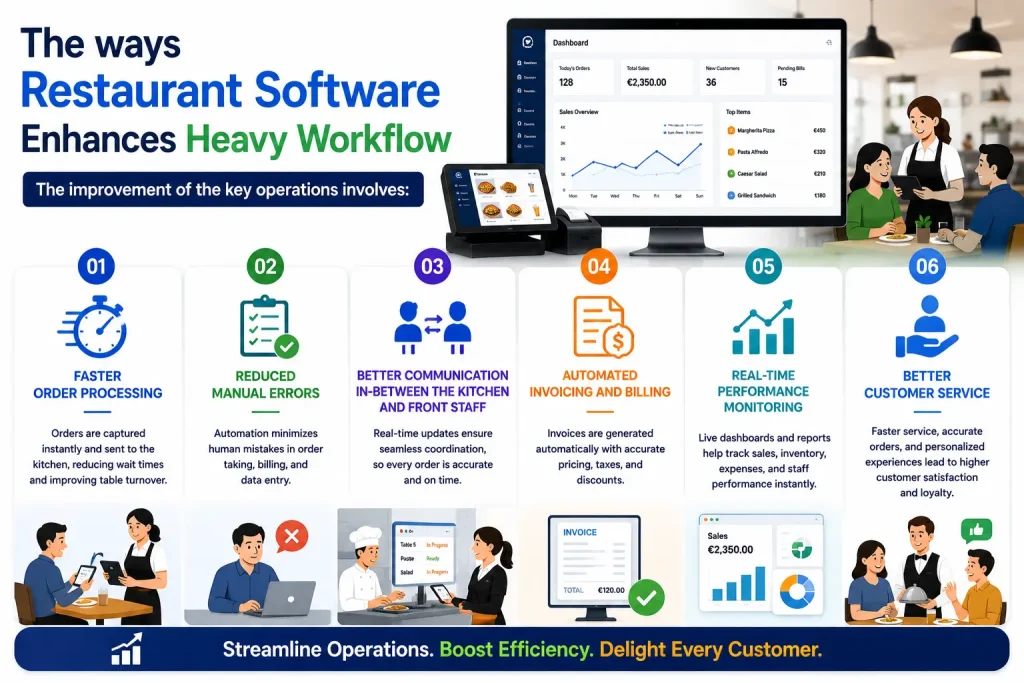
The ways Restaurant Software Enhances Heavy Workflow:
Running a restaurant has lots of moving components. There are orders to be made correctly, there are ingredients to be available, there are employees that are to be arranged and then there are customers who demand great services.
A trustworthy restaurant software will perform these functions automatically and decrease the workload of employees.
The improvement of the key operations involves:
- Faster order processing
- Reduced manual errors
- Better communication in-between the kitchen and front staff.
- Automated invoicing and billing.
- Real-time performance monitoring
- Better customer service
As robotics decide on routine duties, restaurant staff are now able to lay more emphasis on customer service priorities and expansion of the business.
The Growing Importance of Restaurant Software POS:
The restaurant software POS system is one of the most important aspects of any restaurant nowadays.
A POS serves as the main center of the transaction, orders, and payment. Contemporary POS has so much more to it than mere payment processing.
High-end restaurant POS systems are able to:
- Record in real time sales.
- Track inventory automatically
- Monitor employee performance
- Generate detailed reports
- Manage loyalty programs
- Allow various payment.
Through installing a restaurant software POS, Oman restaurants can greatly enhance the accuracy of transaction and they also improve customer convenience.
The need of Restaurant POS Systems to help grow the business:
Restaurants are increasing in size, making it all the more challenging to manage manually. Many branches, bigger menus, and the increase in the number of customers complicate operations.
The POS systems of modern restaurants offer centralized management and visibility of all restaurants.
Benefits include:
Real-Time Sales Monitoring:
The managers will be able to see instant sales, the busiest times and which menu items are doing best.
Better Decision Making:
Proper reports will assist the restaurant owners to determine products that sell, as well as to come up with the best prices.
Multi-Branch Management:
Chains of restaurants will be able to observe performance in different locations and through one dashboard.
Enhanced Customer Experience:
Intensified service and proper orders fulfillment contributes to customer satisfaction and returns.
Restaurant POS systems have become a necessity and not an option to restaurants aiming to scale to greater levels.
A Restaurant Management System Inventory Management.
Profitability is directly related to food inventory. Overstocking results in wastage and understocking results in missed business and customers not getting their needs.
A contemporary restaurant management system would assist the restaurants to ensure that they have the optimum levels of inventory that are monitored in real time.
Inventory advantages will include:
Automated Stock Tracking:
Inventory records are updated automatically with each sale.
Waste Reduction:
Managers are able to determine overuse and will be able to minimize the waste food.
Supplier Management:
The restaurants are able to simplify the buying process and ensure good relations with suppliers.
Accurate Forecasting:
Previous sales data is useful in estimating future need of the inventory.
Enhanced inventory management can help restaurants safeguards profit margins and cuts the operation cost.
Possessing the POS Systems and their relevance to Customer Satisfaction:
In the hospitality industry, customer expectations keep on increasing. Waiting too long, putting the wrong bill to the wrong restaurant, and failing to give the right orders may adversely affect the reputation of a restaurant.
Modern POS Systems are used to enhance customer experiences by:
- Faster order processing
- Accurate billing
- Digital receipts
- Multiple payment options
- Loyalty program and rewards programs.
- Table management capabilities
Customers are more inclined to become repeaters and recommend the restaurant to others when their service is consistent, and their orders are correct.
The need to have POS Software in Oman:
The use of POS Software in Oman has been growing at high pace with the uptake of digital transformation programs by businesses.
The nature of government regulations, customers preferences and competitive market conditions are pushing restaurants to modernise their operation.
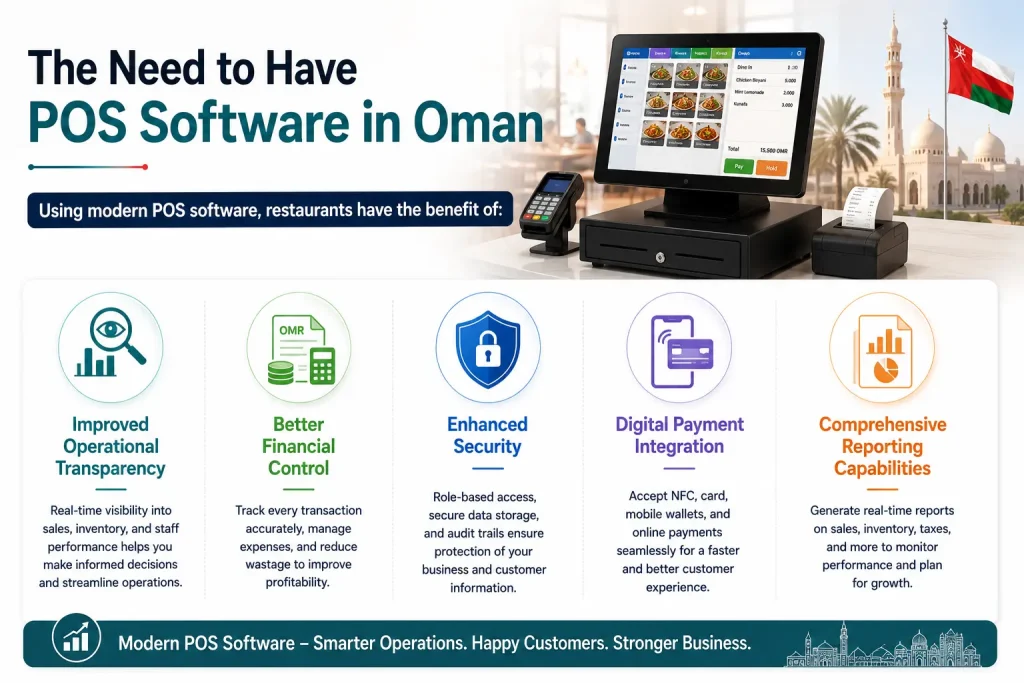
Using modern POS software, restaurants have the benefit of:
- Improved operational transparency
- Better financial control
- Enhanced security
- Digital payment integration
- Comprehensive reporting capabilities
With Oman progressing in digital economy, restaurants based on technologies will have a higher chance of achieving long-term success.
The integration of Resto management systems and ERP Solutions:
Most of the restaurant businesses tend to overgrow stand-alone systems and need more business handling competencies.
The erp software in oman solution of integrating a restaurant management platform along with an erp software develops a single-business ecosystem.
This integration enables restaurants to be linked:
- Finance and accounting
- Procurement
- Human resources
- Payroll management
- Inventory management
- Sales reporting
The total erp system implementation in the oman offers more visibility and control over business operations and facilitates future growth.
Coupled with a reliable erp software company, integrating restaurant systems with enterprise management systems becomes easier.
As a company grows, collaboration with an erp company may assist in developing a digital infrastructure that is scalable to help achieve long-term success.
Best Practice Data-Driven Decision Making to be a Successful Restaurant:
The winning restaurants use correct information as opposed to assumptions.
Contemporary restaurant management software produce finer reports that include:
- Daily sales
- Menu performance
- Employee productivity
- Inventory consumption
- Customer preferences
- Profit margins
These lessons enable managers to make good business decisions and know where they can make things better.
Data solutions allow restaurants to become more efficient, cost effective and add to profitability.
The Way forward: Future-proofing restaurants with technology:
The world of restaurants is growing more and more technological. It has become a norm to enable online methods of ordering, delivery systems, e-payment systems and customer rewards programs.
The restaurants will be more compatible with the requirements of tomorrow.
A restaurant management system will be the basis of:
- Online ordering integration
- Delivery management
- Customer relationship management
- Mobile payment solutions
- Advanced business analytics
Innovation will help restaurants to stay competitive in a highly changing market place.
Conclusion:
Oman restaurant industry is turning competitive and customer oriented. The management practices that were common before cannot sustain the need of the modern-day restaurant management.
A holistic restaurant management system assists companies to simplify the working processes, enhance customer experiences, minimize wastes and losses of foods, streamline inventory and maximize profits.
With cutting-edge restaurant software POS solutions and built-in ERP Software features restaurant owners are able to have full control over their operations as well as position their businesses towards sustainable growth.
A restaurant management system is one of the most intelligent investments that restaurants who want to be efficient, scaled and successful in the long-term can make a decision to invest in.
FAQs
A Restaurant Management System refers to software that assists restaurants in running various operations like billing, order processing, tracking inventory, employee scheduling, customer management and reporting; all through a unified platform.
The restaurants in Oman require Restaurant Management System that will enable them to enhance efficiency, minimise manual errors, manage inventory, improve customer service and have real time insight of the business performance.
The system automates the routine activities like order processing, billing, updating inventory and generating reports. This also decreases workload, reduces mistakes made; and enables the staff to concentrate on customer service.
Yes. The system assists restaurants both to determine patterns of waste and to optimize their purchasing behavior and maintain adequate inventory levels by monitoring the amount of inventory and the amount of ingredients consumed in real time, and greatly decreasing food waste.