Skip to main content
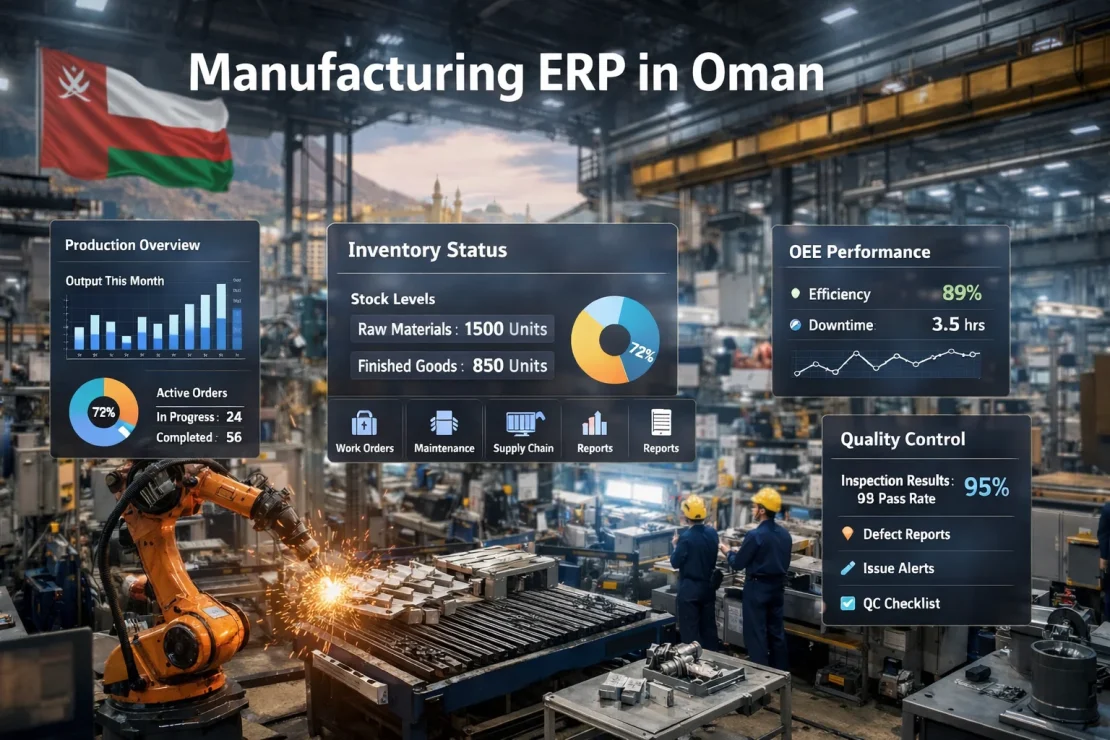
With Oman in the early days of its industrial development as part of Vision 2040, manufacturing companies are faced with the growing demand to modernize, become more efficient, and competitive. This growth can no longer be supported by manual processes, isolated systems and lack of visibility. Here the Manufacturing ERP system in Oman will become a strategic requirement and not a technical upgrade.
This paper clarifies the nature of Manufacturing ERP, its importance to Omani manufacturers, its main characteristics, advantages, implementation methods and approaches to selection and implementation of the optimal solution to ensure long-term success.
What Is Manufacturing ERP?
Manufacturing ERP is a unified software application that specifically aims at automation and control of the manufacturing essential processes. Process manufacturing ERP software, in contrast to generic ERP software, is aimed at production processes, inventory, quality, cost, and employee coordination in one centralized system.
Strong Manufacturing ERP integrates departments like production, procurement, finance, HR and supply chain which would have real time data flow and operational transparency.
The difference between SowaanERP and either NetSuite or Generic Manufacturing ERP:
Although global solutions such as NetSuite have generalized ERP functionality in a global sense, they are not usually localized and flexible in local industries to suit local manufacturers. SowaanERP is business-friendly specifically to Middle Eastern and it provides:
- Localization met the Oman requirements of regulations and operations.
- Manufacturing, finance, HR, payroll modules are inbuilt.
- Quick implementation and customization.
- Regional support and training.
This will make SowaanERP a feasible and scalable Manufacturing ERP software in Oman and particularly among SMEs and developing businesses.
The reason why Oman Manufacturers require ERP Solutions:
The manufacturing sector of Oman is on the rise in the food processing, construction materials, chemicals, and metals, and consumer goods sector. Nevertheless, most manufacturers continue to struggle with operations that inhibit their growth.
Key Local Challenges:
- Disjointed production, inventory and financial systems.
- Inventory tracking via manual means that results in a shortage or overstock.
- Increased labour expenses, and complexity of workforce management.
- Improving compliance and quality requirements.
- Exception to develop exports and global standards.
ERP Advantages in the context of Omani Manufacturers:
By using ERP solutions in manufacturing, businesses will be able to:
- Effortlessly plan production and use of resources.
- Enhance coordination in the supply chain with suppliers.
- Enhance the productivity of the workforce by employing integrated HR software in Oman.
- Traceability and compliance promote export preparation.
- Observe real-time information to aid in strategic decision-making.
The principal characteristics of the ERP in manufacturing include:
The following are the main key features of a modern Manufacturing ERP system in Oman all of which are meant to facilitate end-to-end manufacturing operations.
- Planning and Scheduling of Production:
ERP also fits the customer demand with the production capacity, which guarantees the optimization of schedules, minimization of down-time and optimization of resources.
- Inventory Management:
Inventory refers to the quantity of goods that are carried at a specific time
Inventory Management system shows raw material, work in progress and finished goods in real time to enhance coordination between suppliers and minimise holding costs.
- Quality Control & Compliance:
ERP manufacturing will guarantee uniform quality: by checking all the inspection records, including the batch traceability and the compliance documentation needed to conduct audits and exports.
- Finance & Cost Management:
ERP will deliver production data with accounting to enable the provision of precise job costing, margin analysis and financial reporting, all through one system.
- Shop Floor Control and Real Time Monitoring:
Manufacturers are able to see work orders, machine production, and efficiency in production live which facilitates problems to be solved faster and throughput to be improved.
- HR & Labor Management:
HR software is built-in in Oman and payroll software is built-in in Oman to simplify the process of scheduling workforce, tracking attendance, calculating overtime and meeting the demands of local labor regulations.
- Analytics & Reporting:
KPIs and dashboards give visible information on actionable data regarding efficiency in production, inventory turnover, costs, and workforce performance.
ERP and its benefits to your business through manufacturing:
A full Manufacturing ERP implementation presents the following quantifiable business value:
- Increased productivity by automating the processes.
- Live access to production, inventory and finance.
- Reduced operation and wastage expenses.
- Better supply chain coordination.
- Smart decision-making on quality data.
These advantages promote the operational resiliency and sustainable growth directly.
Cloud vs On-Premise ERP:
The proper deployment model is the key to success in the long term.
Cloud ERP – Pros & Cons:
Pros:
- Lower upfront costs
- Faster deployment
- Scalability and automatic updates.
- Remote access to data
Cons:
- Reliance on the internet connectivity.
- Ongoing subscription costs
On-Premise ERP – Pros & Cons
Pros:
- Greater control over data
- One-time licensing cost
- It is appropriate to stringent internal IT policies.
Cons:
- Higher initial investment
- Continued maintenance liability.
- Limited scalability
Which Option Is Right?
The erp software process manufacturing will be more advantageous to SMEs and expanding producers in Oman.
Big businesses with their sophisticated infrastructure might choose to go on-premise or hybrid.
Selection of the Appropriate Manufacturing ERP:
The choice of the appropriate system has to be evaluated.
The following are some of the important considerations that should be made:
- Specialized industry manufacturing characteristics.
- Scalability to enable the growth in the future.
- Integration with other systems.
- Local vendor support and training are available.
- The overall cost of ownership, and not only licensing.
It is strongly advisable to request a manufacturing ERP demo in order to evaluate real-world usability before the final decision is made.
Differentiated ERP Implementation Guide:
Planned implementation strategy reduces risks and makes it successful.
- Requirement Analysis:
Establish business objectives, gaps in operations and anticipated results.
- Vendor Selection:
Screen ERP suppliers in terms of functionality, localization and support.
- System Customization:
Compile workflows, modules and reports to suit business requirements.
- Data Migration:
Move the correct master data, inventory data and financial history.
- User Training:
Members of train project in production, finance, HR, and management.
- Go-Live & Testing:
Before full deployment, all modules can be tested.
- Post-Implementation Support:
The continuous support provides the system stability and optimization.
Conclusion:
The current Manufacturing ERP system in Oman is no longer an option that manufacturers wish to scale, compete, and comply with emerging demands in the market. ERP integrates production planning and inventory control, finances, human resource, and analytics into one smart platform.
Solutions such as SowaanERP can make manufacturers smarter and grow faster with the help of localized features, flexible deployment, and integrated payroll software in Oman and the functionality of the HR.
Are you willing to change your manufacturing processes?
Arrange a customized manufacturing ERP demo or talk with our specialists and see how the correct ERP can future proof your business in 2026 and beyond.
FAQs
ERP manufacturing involves production planning, inventory control, quality control, finance, human resource, payroll, analytics, and supply chain management.
The implementation process normally requires 3-6 months based on the size of the business, customization, and complexity of the data.
Yes, the modern erp solutions for manufacturing have been made to accommodate the multi-location operation, currencies and regional compliance.
ERP manufacturing is a single-system, which is used to consolidate production, inventory, finance, HR, and reporting to optimize the manufacturing process throughout.