Skip to main content
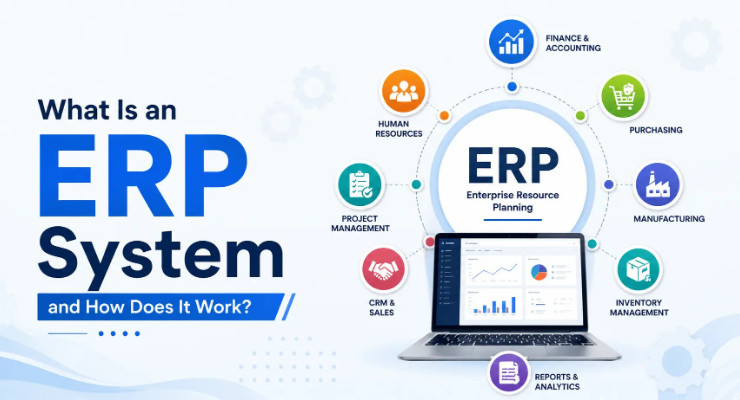
In today’s competitive business world, organizations are required to have efficient means of managing operations, enhancing productivity and keeping proper records. Running a multitude of systems for various departments becomes challenging as businesses expand. This is where an erp system oman comes into play. Enterprise Resource Planning (ERP) Solutions are designed to help companies streamline their operations and consolidate different functions into a single solution.
But, in any department, from finance to sales, inventory to procurement, or HR, an ERP system offers a centralized solution that boosts efficiency and aids in informed decision-making. ERP software can be a big leap to success for enterprises looking to digital transformation.
What is ERP System?
An ERP system is a type of software that combines essential business functions in a single application. Businesses can handle all aspects – accounting, inventory, sales, customer service, and HR – from one system, rather than having separate applications.
The main advantage of an ERP is to establish a single database where various departments can share information in real-time. This will remove data silos, minimize data duplication, and provide access to accurate and up-to-date data for all teams.
For instance, upon the creation of a sales order, the ERP system can automatically adjust inventory, create an invoice and offer financial data without having to manually input data into various systems.
ERP systems are employed across all business sizes to enhance operational effectiveness, boost visibility and aid business growth.
Understanding ERP:
Today ERP technology has grown beyond just simple accounting software to a full-fledged business management software. Currently, ERP helps businesses today to automate time-consuming tasks, monitor performance metrics, and get insights from their business operations with reporting and analytics.
For example, ERP includes some standard modules like:
- Finance and Accounting
- Human Resources
- Payroll Management
- Inventory Management
- Procurement
- Sales and CRM
- Manufacturing
- Project Management
- Asset Management
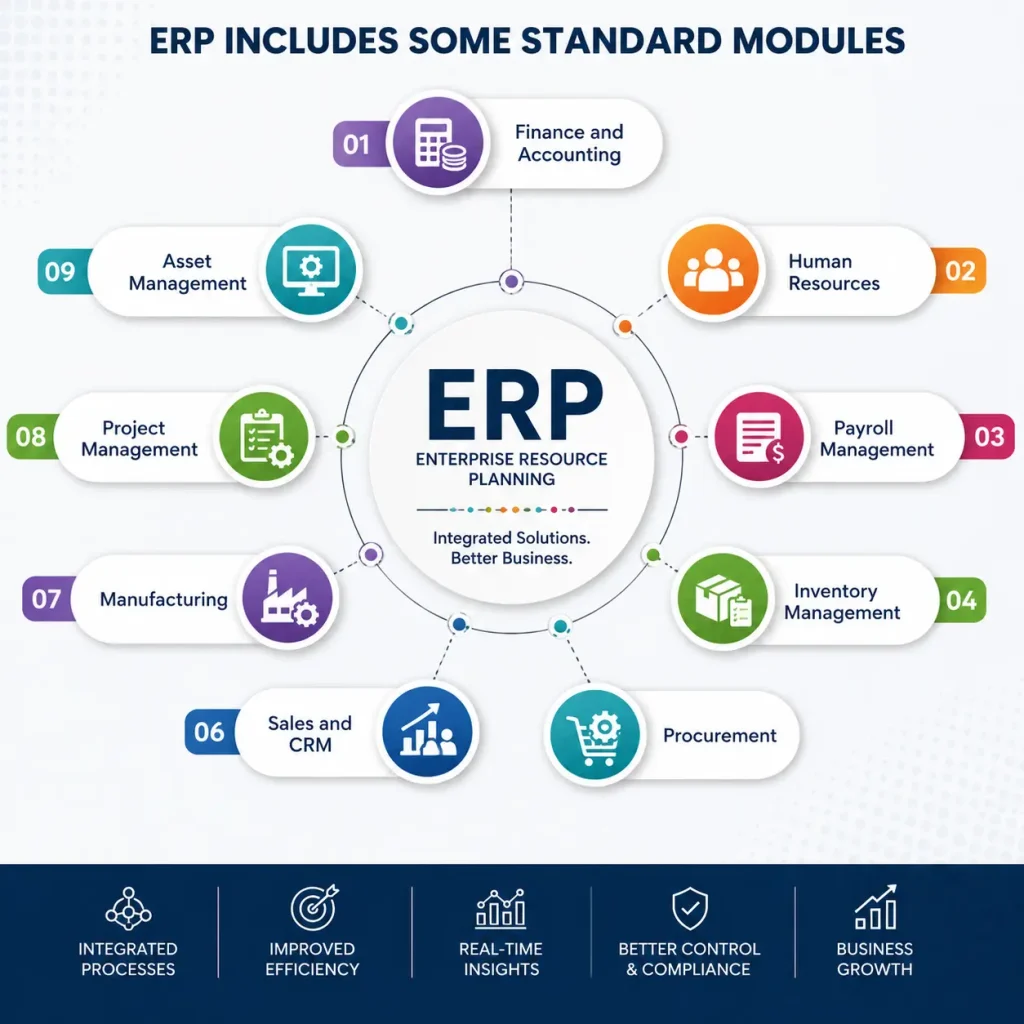
All of these modules are able to gain a holistic view of business activities.
Typically, the process is as follows:
Data Collection:
The information is entered by the employees via different modules of the ERP software. This can be sales orders, purchase requests, payroll information, inventory updates or customer information.
Centralized Database:
All entered data is backed-up in a Centralized Database. This avoids the use of separate spreadsheets and disjointed systems.
Real-Time Processing:
The new information added to the ERP system is automatically updated as well. For example, upon completing a sale, inventory, financial reports and customer record are all automatically updated.
Automation of Workflows:
ERP software streamlines day to day operations of the business, such as generating invoices, calculating wages, authorizing purchases and restocking supplies.
Reporting and Analytics:
Manager then gets access to Dashboards and Reports that provide up to the minute information about business performance thus helping them to make informed business decisions.
ERP systems streamline operations and boost efficiency by linking the various departments and automating tasks.
ERP Software and Its Key Features:
ERP software is also available with a variety of features that can help businesses manage their operations more easily. Although this can differ from provider to provider, most solutions have the following capabilities:
Financial Management:
ERP software facilitates businesses to handle accounting, budgeting, cash flow, accounts payable, accounts receivable, and financial reporting.
Inventory Management
Now companies can keep track of stock, know when inventory is moving, minimise wastage and enhance order fulfillment.
Human Resource Management:
ERP systems automate the management of employees, tracking employee attendance, processing payroll, recruitment, and evaluating employee performance.
Customer Relationship Management:
The integrated CRM features enable businesses to handle leads, client interactions, sales prospects, and customer support.
Procurement Management:
Businesses can streamline their procurement processes, keep track of their supplier relationships, and efficiently manage their procurement costs.
Reporting and Business Intelligence:
ERP software offers detailed reports and dashboards, providing valuable insights into operational and financial performance.
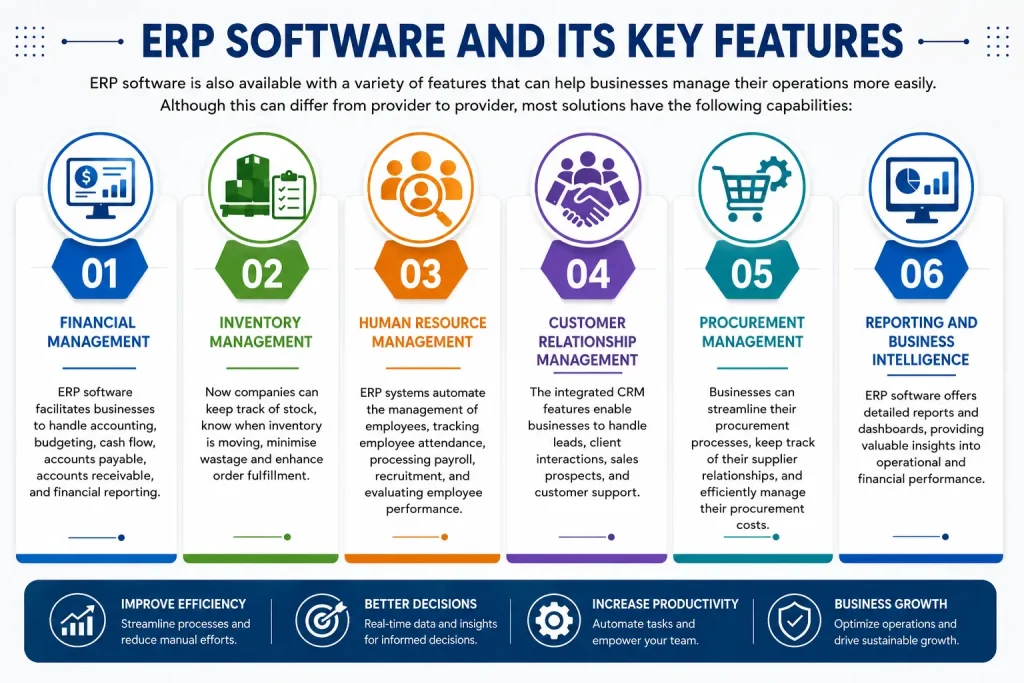
These capabilities allow businesses to enhance productivity while offering more control over business processes.
ERP Software in Oman:
As businesses in Oman strive to stay up to date with their operations and meet changing regulations, the demand for ERP software has grown considerably. Regardless of the sector, be it retail, manufacturing, construction, healthcare, or services, companies are increasingly turning to ERP solutions to enhance their efficiency and competitiveness.
A key factor for businesses in Oman is ensuring adherence to the rules and regulations of VAT in Oman. Manual taxation management can lead to errors and time-consuming processes. ERP software can assist organizations in keeping accurate records, automatically calculating taxes, and creating reports for compliance.
ERP software in Oman can offer advantages to businesses, such as:
- Improved financial visibility
- Automated tax management
- Better inventory control
- Enhanced employee management
- Faster decision-making
- Increased operational efficiency
In the ever-changing landscape of Omani business, ERP is proving to be an invaluable resource for sustainable growth.
The best ERP software in Oman is a crucial necessity for businesses for several reasons:
The decision of which ERP software is best for Oman is a crucial one that can affect business performance. The correct answer can aid businesses in handling resources more effectively and can also help them to grow.
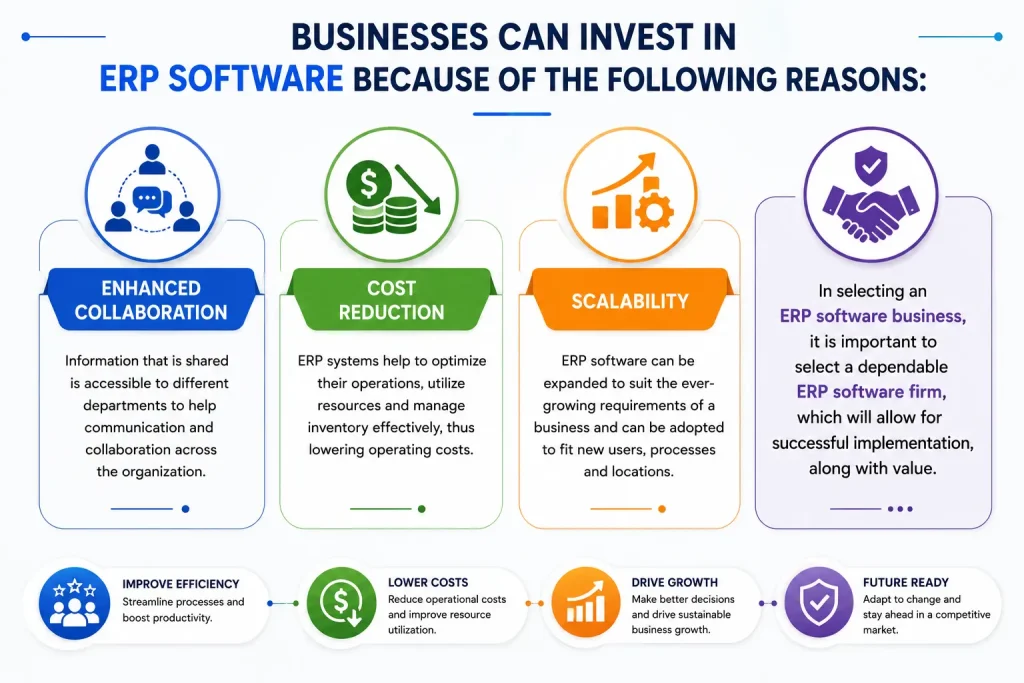
Businesses can invest in ERP software because of the following reasons:
Enhanced Collaboration:
Information that is shared is accessible to different departments to help communication and collaboration across the organization.
Cost Reduction:
ERP systems help to optimize their operations, utilize resources and manage inventory effectively, thus lowering operating costs.
Scalability:
ERP software can be expanded to suit the ever-growing requirements of a business and can be adopted to fit new users, processes and locations.
In selecting an ERP software business, it is important to select a dependable ERP software firm, which will allow for successful implementation, along with value.
How ERP Software Company can succeed business:
A professional ERP software company can offer you more than just software. It provides implementation support, customization, training and maintenance services to maximize a business’ investment value.
A good ERP provider assists an organization to:
- Identify operational challenges
- Set up ERP modules based on the requirements of the business
- Move data safely from one place to another
- Train employees effectively
To guarantee system performance and security, you should verify that all components of your system are connected.
ERP systems and VAT in Oman:
Businesses in Oman must take into account the compliance with VAT. Manual tax calculation management can lead to greater risk of tax errors and penalties.
In Oman, ERP systems facilitate businesses to manage VAT by:
- Automating tax calculations
- Generating VAT-compliant invoices
- Correct bookkeeping and accounting procedures
- Generating tax reports in a timely fashion
- Supporting regulatory compliance
VAT integration enables companies to streamline their VAT procedures while boosting precision.
Conclusion:
ERP software is a vital asset to the growth and competitiveness of organisations in the era of digital transformation. For businesses seeking ERP software in Oman, the advantages include a better control of the finances, increased productivity, smoother operations, and adherence to VAT regulations.
By selecting the most suitable ERP software in Oman and relying on a trusted ERP software company, organizations can tap into long-term success and sustainable growth.
FAQs
An ERP system is a form of software that brings together several business processes like sales, procurement, human resources and accounting, etc., in one central system to make things easier, more efficient and better-managed.
2. What is the working of an ERP system?
The main principle of an ERP system is to gather data from various departments and save it in a centralized data source. This enables data sharing in real-time, automation of workflows and true reporting throughout the organization.
3. What’s the reason behind businesses using an ERP system?
For businesses to improve operations, boost productivity, minimize manual work, enable better collaboration and offer real-time insights into business performance, there’s a need for an ERP system.
4. How ERP can be beneficial for business?
The advantages of ERP include helping to automate repetitive tasks, streamline information, boost data precision, truly improve resource utilization and delivering valuable information to help you make better business decisions.